Most optimisation starts with three questions
In route optimisation, we usually ask questions such as:
These are fundamental objectives in solving TSP, VRP and other multi-stop
routing problems.
But in real logistics operations, there is another consideration that becomes
increasingly important as routes become longer:
That is particularly important for long last-mile routes, where a small
routing decision early in the shift can determine how many customers are
affected several hours later.
For a route starting from a depot or terminal, it may feel natural to serve
nearby stops first and progressively move towards more distant areas.
Interestingly, that sequence is not always the mathematically shortest or
fastest route.
In some cases, an optimiser can reduce total distance by travelling towards
a more distant cluster early, returning through another area later, or
following a sequence that does not simply progress from the closest deliveries
to the farthest ones.
Operationally, however, there is another side to the problem.
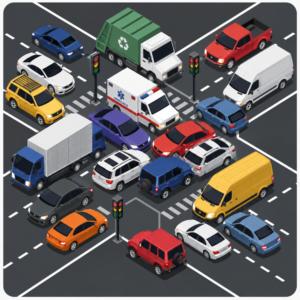
What happens when the day does not go according to plan?
A route plan assumes that the operation will progress approximately as expected.
But real delivery operations contain uncertainty.
When something unexpected happens late in a long route, the important question
is not only:
This creates an interesting trade-off in route optimisation.
A route that prioritises nearby stops earlier may be slightly longer overall,
but it can complete a larger number of deliveries earlier in the shift.
If a major disruption then occurs, fewer customer orders remain exposed to
the delay.
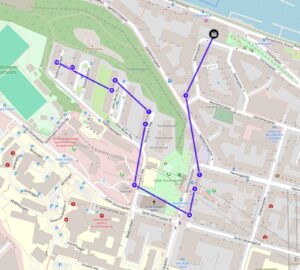
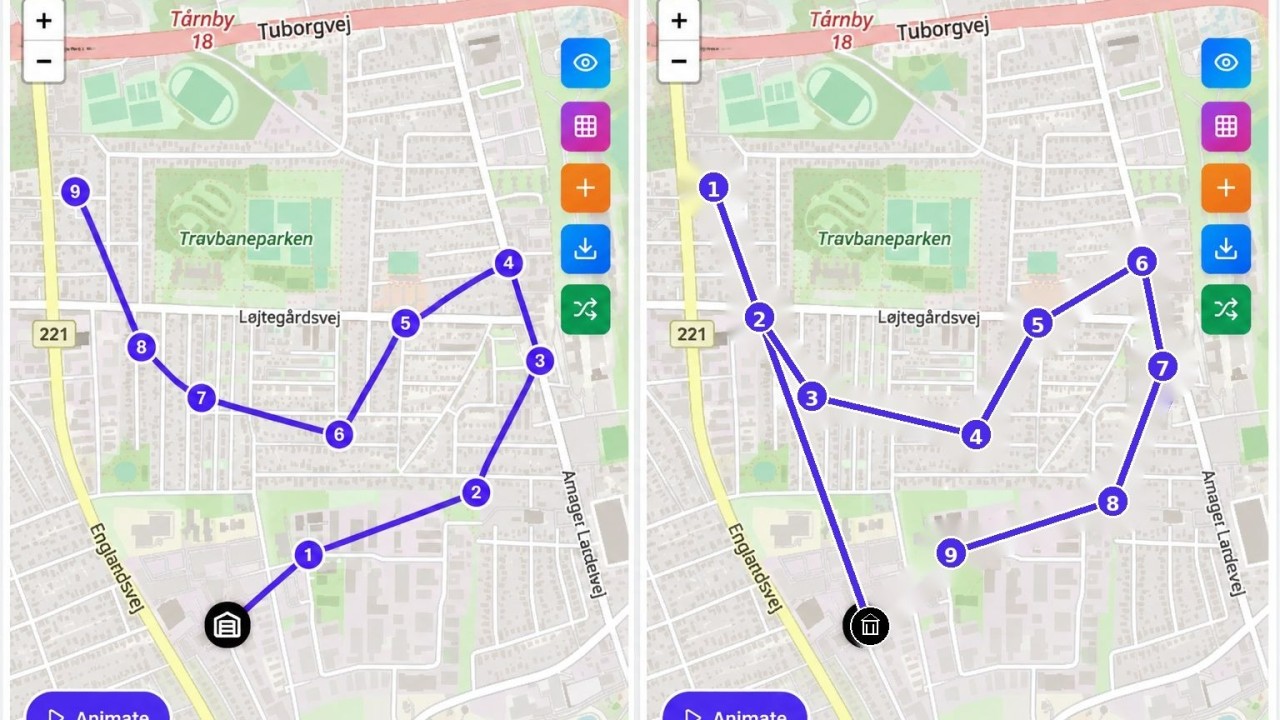
60 stops. Two valid routes. Two very different outcomes.
Consider an illustrative route containing 60 delivery stops.
is located farther away.
32 of 60
42 of 60
of the shift.
fewer parcels remain exposed to the disruption in this illustrative scenario.
The second route travelled slightly farther, but significantly fewer customers
are exposed to the disruption.
The numbers above are only an illustrative example, but the operational
trade-off is very real.

So what is actually the “best” route?
This is why defining the ”best route” is more difficult than simply minimising
distance or duration.
The optimiser may need to balance two objectives:
These objectives can sometimes conflict.
Giving too much weight to early completion could create inefficient routes with
unnecessary additional kilometres.
Giving no weight to it at all may create mathematically excellent routes that
expose a larger number of deliveries to late-shift operational uncertainty.
The longer the route, the more uncertainty matters
For a route with 10 or 15 stops, this consideration may have relatively little impact.
But the situation changes when a courier is expected to visit 50, 60, 80 or more
stops during one shift.
10 stops
15 stops
50 stops
60 stops
80+ stops
The longer the route, the greater the exposure to uncertainty throughout the day.
Then how do we solve this efficiently?
improvement in operational robustness.
The goal is not to enforce a rigid rule saying that the closest stop must always
be visited first or that the farthest stop must always be last.
That would itself produce poor solutions in many routing problems.
Instead, the optimisation process can consider the operational benefit of
progressively completing deliveries while still protecting overall route efficiency.
How we reflect this philosophy in our optimisation engine
The goal is not to replace mathematical optimisation with a collection of rigid
operational rules.
Instead, this philosophy is reflected in several other aspects of TrendRoute.ai: