When a “Smart” Routing System Repeats the Same Dumb Mistake
Why route optimisation engines need to learn from repeated driver corrections
A route optimisation system can be mathematically sophisticated and still lose the trust of the people who use it every day.
For a courier or driver, intelligence is not judged by how advanced the algorithm sounds. It is judged by something much simpler:
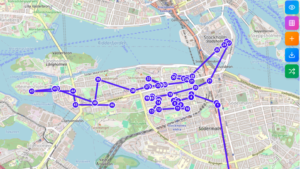
Imagine a courier who delivers parcels in the same part of Stockholm every day.
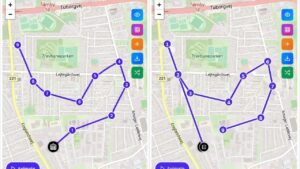
The routing system generates a sequence of stops. Most of the route looks reasonable, but it repeatedly suggests travelling from Stop 1 directly to Stop 6.
On the map, those locations appear relatively close.
The problem is that there is no practical direct connection between them by car. The apparently convenient connection is suitable for pedestrians, not for the delivery vehicle.
The driver already knows this.
So every time this situation occurs, the driver ignores the suggested sequence after Stop 1, serves other locations first, and returns to Stop 6 later through a more practical driving route.
Once is understandable.
Twice may still be acceptable.
But when the same mistake appears repeatedly over many delivery days, something more important starts to happen:
And once that confidence is lost, the problem can spread far beyond this single location.
Trust is part of route optimisation quality
A courier who repeatedly sees obviously impractical suggestions eventually develops a different behaviour:
Sometimes the driver will be right.
But not always.
The dangerous part is that distrust created by one genuinely bad routing decision can lead the driver to override other parts of the route that were already well optimised.
The result may be:
- More unnecessary manual route changes
- Longer driving distance
- Higher route duration
- Increased risk of late deliveries
- Less predictable ETAs
- Lower confidence in future optimisation results
So the cost of one repeatedly unresolved routing issue can become much larger than the few additional kilometres associated with that particular mistake.
The example: when the map and the operation disagree
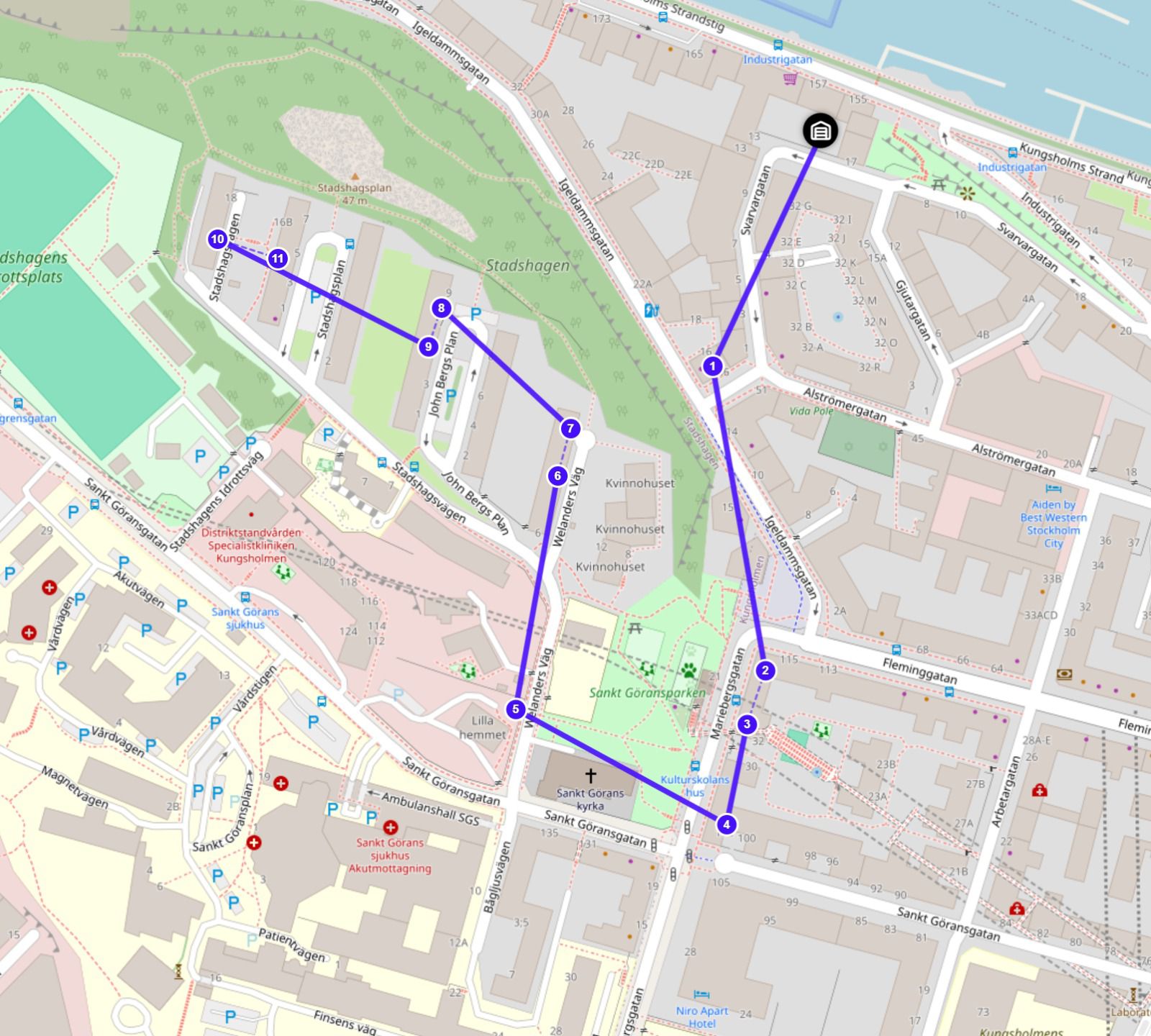
Consider the Stockholm example shown below.
The system repeatedly suggests moving from Stop 1 to Stop 6.
Geographically, the locations look close enough for the sequence to make sense.
Operationally, however, the direct connection is not appropriate for the vehicle. The apparent shortcut is effectively a pedestrian connection.
An experienced driver quickly learns that a different sequence works better and modifies the route.
The important question is not whether the driver can correct it.
Of course the driver can.
The important question is:
If the answer is nothing, then the same driver – or another driver – may have to discover and correct the same issue again.
That is not really an intelligent system.
There are three ways to deal with this
Let the driver fix it every time
This is probably the simplest approach, and it is still common in delivery operations.
The optimiser generates the route.
The driver notices something wrong.
The driver changes the sequence.
The delivery is completed.
Problem solved – at least for today.
But the knowledge stays inside the driver’s head.
Tomorrow, the optimisation engine may produce exactly the same mistake.
Another driver may receive the same route and have to discover the same problem again.
Over time, this approach creates two important issues.
First, the driver gradually loses confidence in the optimisation system and begins making more decisions independently.
Second, valuable local operational knowledge is not shared across the fleet.
One experienced courier may know hundreds of small details about a city:
- Which streets cannot practically be approached from a particular direction
- Which apparent shortcuts are pedestrian-only
- Which entrances are on the opposite side of a building
- Which gates are normally closed
- Which streets are technically accessible but operationally impractical
If this knowledge never leaves the individual driver, every new courier has to learn it again.
Let drivers report problems and fix them manually
A much better approach is to give drivers and dispatchers a mechanism to report routing problems.
For example:
The issue can then be reviewed by the technical or map team.
If confirmed, the relevant map configuration, access rule, routing parameter or optimisation behaviour can be corrected.
This is already a significant improvement because operational knowledge can become organisational knowledge.
Once corrected, every driver benefits.
However, this model also has limitations.
Every report may require:
- Investigation
- Map analysis
- Engineering effort
- Testing
- Validation
- Deployment
The technical team also has to determine whether the driver’s observation represents a persistent problem or simply an unusual one-time situation.
A driver may have changed the route because of temporary construction, an accident or today’s traffic.
That does not necessarily mean the underlying routing logic should permanently change.
When a fleet generates thousands of routes every day, manually investigating every route modification can become difficult to scale.
Let AI identify repeated patterns of disagreement
This is where AI and operational feedback can become particularly useful.
Instead of treating every driver modification as an isolated event, the system can analyse route execution and corrections over many days.
Suppose it observes that:
- The optimiser repeatedly proposes 1 → 6
- Multiple drivers repeatedly avoid that sequence
- They consistently choose another geographical progression
- Actual execution data confirms that the alternative performs better
- The behaviour persists across different days and traffic conditions
Now the system has much stronger evidence that something systematic may be wrong.
AI can detect this recurring disagreement and investigate possible causes.
Is there a map-access problem?
Is a pedestrian connection incorrectly influencing vehicle routing?
Is the travel-time matrix unrealistic?
Is there an incorrect turn or road restriction?
Is the clustering or sequencing algorithm repeatedly making a poor local decision?
The system can then propose a correction – or, where sufficient safeguards exist, apply a bounded correction automatically – and report the change to the responsible technical team.
Instead of asking engineers to investigate every individual driver complaint, the system helps identify the cases where repeated operational evidence indicates that a genuine problem exists.
From individual experience to fleet-wide intelligence
This creates an important learning loop:
And perhaps the most valuable part is that the knowledge no longer belongs to only one courier.
If one experienced driver repeatedly identifies a real geographical issue, that experience can eventually improve routes for:
- Other drivers
- New employees
- Other shifts
- Future delivery days
The routing engine effectively converts individual operational experience into shared routing intelligence.
That is a very different model from a static optimiser that produces a new route every morning but learns nothing from what happened yesterday.
AI should not blindly copy every driver
There is an important caution here.
A driver’s modification should not automatically be considered correct.
Humans also make suboptimal decisions.
A courier may prefer a familiar route even when another sequence is objectively better.
A temporary road closure may exist today but disappear tomorrow.
Traffic may force an unusual deviation on one particular day.
So the goal should not be:
A stronger approach is:
That requires combining several signals:
driver behaviour, historical execution, map information, route metrics, travel time and repeated observations across different days.
That is where AI can provide considerably more value than simply placing an “AI-powered” label on a conventional routing algorithm.
The real objective is not only better routes – it is trusted routes
A mathematically excellent route has limited value if the driver does not follow it.
This is why one of the harder challenges in route optimisation is not simply finding a low-cost solution.
It is creating a system that dispatchers and drivers gradually learn to trust.
And trust is built through behaviour.
If the system makes a mistake, that is understandable.
If it makes the same obvious mistake every day and never learns from it, people will eventually stop considering it intelligent.
A truly intelligent route optimisation engine should therefore not only generate routes.
It should be capable of learning from the difference between:
That feedback loop can eventually become one of the most valuable sources of intelligence in the entire routing system.
A question for logistics professionals
I would be very interested to hear how other organisations handle this today.
When drivers repeatedly modify the routes generated by your optimisation system, what happens to that knowledge?
Does it stay with the driver?
Do drivers report it to your technical team?
Do you analyse route deviations systematically?
Or does your optimisation platform actually learn from repeated operational feedback?
How do you build and maintain driver trust in your route optimisation system?
At TrendRoute.ai, this is one of the principles we consider important in the design of a complete route optimisation engine: operational feedback should not disappear after the route is executed. It can become an input for improving map intelligence, route optimisation behaviour, ETA prediction and future route quality.